In the modern world of metalworking, the use of stainless steel, aluminium and high-grade or exotic steel alloys is an ever-increasing trend, while the lack of skilled workers means that a time served welder will often need to be able to sand and polish to the highest standard.
Architects eagerly use such materials in their ultramodern constructions, and it is just as relevant in contemporary interior design, with stainless steel tables and balustrades demanding high specification finishes so there is a constant pressure on the metal fabricator. The material properties of these alloys are indispensable in pharmaceuticals and petrochemicals too. In this world unitised abrasives are a metal fabricator’s best friend in finishing these metals safely and comfortably and meeting customers’ demands.
Unitise Abrasive Construction
Three-dimensional compressed abrasives or ‘unitised abrasives’ consist of crimped nylon threads bonded into an open web structure and impregnated with engineered abrasive grit. These impregnated nylon slabs are stacked to become a solid sheet in a hot press. From these sheets, the various sizes and shapes can then be prepared.
Unitised abrasives come in various thicknesses, grades, grain types and densities, allowing you to finish materials simply and consistently. Unlike traditional abrasives, the aggression is determined less by the grit used and more by the density of the material. The lower the density the more flexible a product is. The higher the density the more aggressive unitised abrasives become.
What’s the difference?
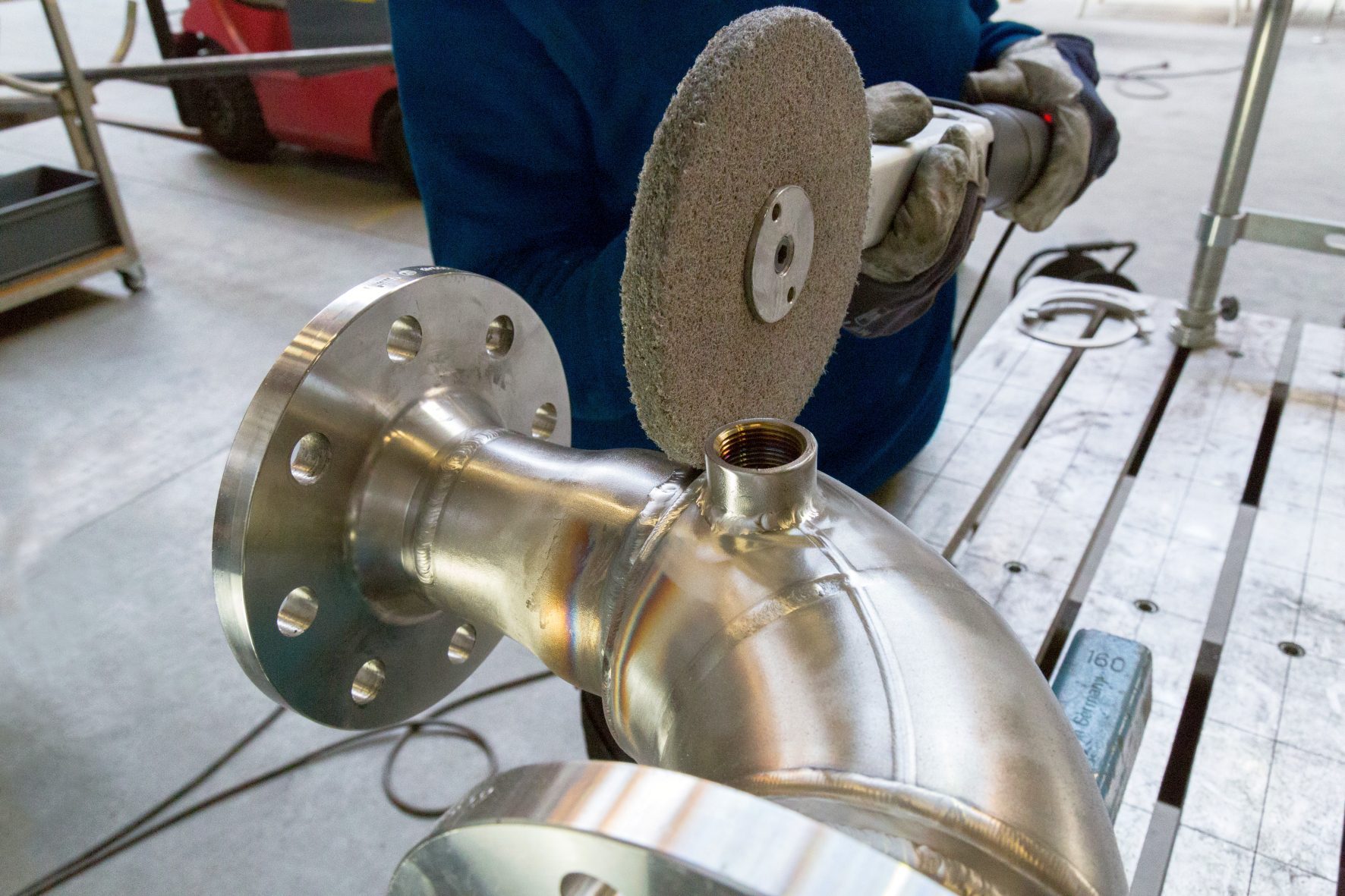
Pick up a piece of sandpaper and press it onto your workpiece and you have an ‘unforgiving’ or hard contact. Press a unitised abrasive onto that same workpiece and the first thing you will notice is that the unitised conforms slightly to the surface. This makes it your new best friend when you need a high-quality finish without the risk of damaging the workpiece. Unitised abrasives combine reasonable aggression with an excellent finish. Perhaps more surprisingly, using a unitised abrasive can often mean that a very high-quality finish can be obtained in fewer steps, making these products very suitable for industrial applications. The unitised material is an excellent addition to the range of traditional abrasives, as it accounts for a perfect, consistent, and reproducible finish of the workpiece after material removal.
An important feature of unitised abrasives is that the material can be easily processed in all sizes and shapes. They are also available in different grit types and densities, making them suitable for a wide range of applications. In standard production the thinnest unitised products can be made as thin as 3 mm in some of the harder densities and as wide as 50 mm with the latest generation FA unitised products.
When to use unitised abrasives
Clearly unitised abrasives will not be suited to every application, but the weakness of traditional coated abrasives is often the strength of the unitised Rebel One family of products. If the most important aspect of your sanding process is aggression and finish is less important then we would recommend using a coated abrasive. If the quality and consistency of finish is all important then it is most definitely worth considering switching to unitised abrasives. A couple of examples that help to evidence where unitised abrasives can be advantageous:
Balustrades in a marine environment
When manufacturing balustrades for use in a marine environment not only is the final finish very important but it is essential to remove any areas that could result in the entrapment of salt and spray. Even the ripples left from a good TIG weld can be enough to trap the salts in the air which will cause rusting. MA8 grade unitised discs will grind and blend the weld while the SA5 will leave a fine burr free super fine finish while removing the risk of undercutting or flat spotting the tubes and railings.
Stainless sheet metal fabrication
The quality of welding in precision sheet metal fabrication work often means that there is very little weld dressing required. The MA8 unitised products will remove the top of the TIG weld and blend to leave a bright finish while the SA5 or MA5 unitised products are ideal if it is only necessary to remove the weld burn.
Achieving a nice finish with classic sanding materials can be very difficult. It requires years of experience on the user’s part to achieve an acceptable result. Even so it takes only the smallest of slips to cause damage that would require reworking. Using unitised abrasives removes that barrier and allows even the less experienced operators to be able to achieve a consistent high-quality finish.
A new way of working
The peripheral speed is important when using unitised abrasives. Too high peripheral speed causes premature wear and overheating of the workpiece. Furthermore, too high a speed makes it more difficult to control the abrasive and thus hinders the quality and homogeneity of the finish. For these reasons we strongly recommend the use of variable speed and low speed, high torque grinders and finishing tools when working with unitised abrasives. Always consult the recommended speeds of the products before starting work.
An additional important factor is work pressure. The advantage of unitised abrasives is that a low working pressure is required to reach the desired finish. Only stable contact with the workpiece is sufficient. The advantage of not having to add extra working pressure again translates into cooler grinding, resulting automatically in a better finish. Lower working pressure also benefits the life of the disc or wheel, as well as added comfort for the user.
Cibo Abrasives
Operating under the banner of Abrasive Finishing Systems in the UK and Ireland, Cibo Abrasives will, this year, be celebrating 75 years in the abrasives industry and 10 years since the company began to manufacture its innovative range of unitised abrasive products. Developed initially for stainless steel manufacturing the Cibo Rebel One range continues to develop and expand and now includes the new and patented Rebel One Combi Unitised products.
The Rebel One Combi discs combine two differential density unitised wheels, with the whole being more than the sum of all parts. The harder core provides the aggression to remove a weld seam fast, while the softer sides of the flexible wheel raise the finish to the highest levels.
And with Cibo’s commitment to sustainable environmental practices it is a great partner for the long term. From day one of the unitised manufacturing programme, Cibo committed to removing Volatile Organic Compounds (VOCs) from the production line. VOCs are the umbrella term for a group of substances that includes fuels and solvents. When these substances vaporize, they contribute to global warming and acidification and threaten our health. Solvents are very commonly used in the production of unitised materials. The entire Rebel One range is unique in this regard. It’s 100% solvent-free, VOC-free, and contains no polymers derived from bisphenol A.