
When welding ferritic steels, especially high-strength grades, magnetic blow can become a real challenge. This phenomenon occurs when magnetic fields interfere with the welding arc, causing instability, spatter, and sometimes making welding almost impossible. Kemppi’s Jani Kumpulainen explains more.
Why magnetic blow happens
Magnetic blow is caused by residual magnetism in the steel. High-strength steels, with their fine grain structure, tend to retain magnetism more easily than regular mild steels. Magnetism can be introduced into the material in several ways — for example: Magnetic lifting cranes commonly used in production halls or previous welding operations, especially when using high DC current.
Once the material becomes magnetized, the magnetic field can distort the electric arc and push it away from the weld joint.
How It Affects Welding
Magnetic blow can disturb all types of arc welding processes. Pulse MAG welding is particularly sensitive to it. TIG and MMA (stick welding) are also heavily affected. Short arc welding is the least sensitive, but still not immune.
In practice, magnetic blow causes arc instability, spatter, and arc breaks. In severe cases, welding becomes impossible because the arc refuses to stay in its intended position.
Measuring magnetism
Magnetic fields in steel can be measured using a gaussmeter or magnetometer, typically in millitesla (mT). While there is no exact threshold, both tests and experience show that:
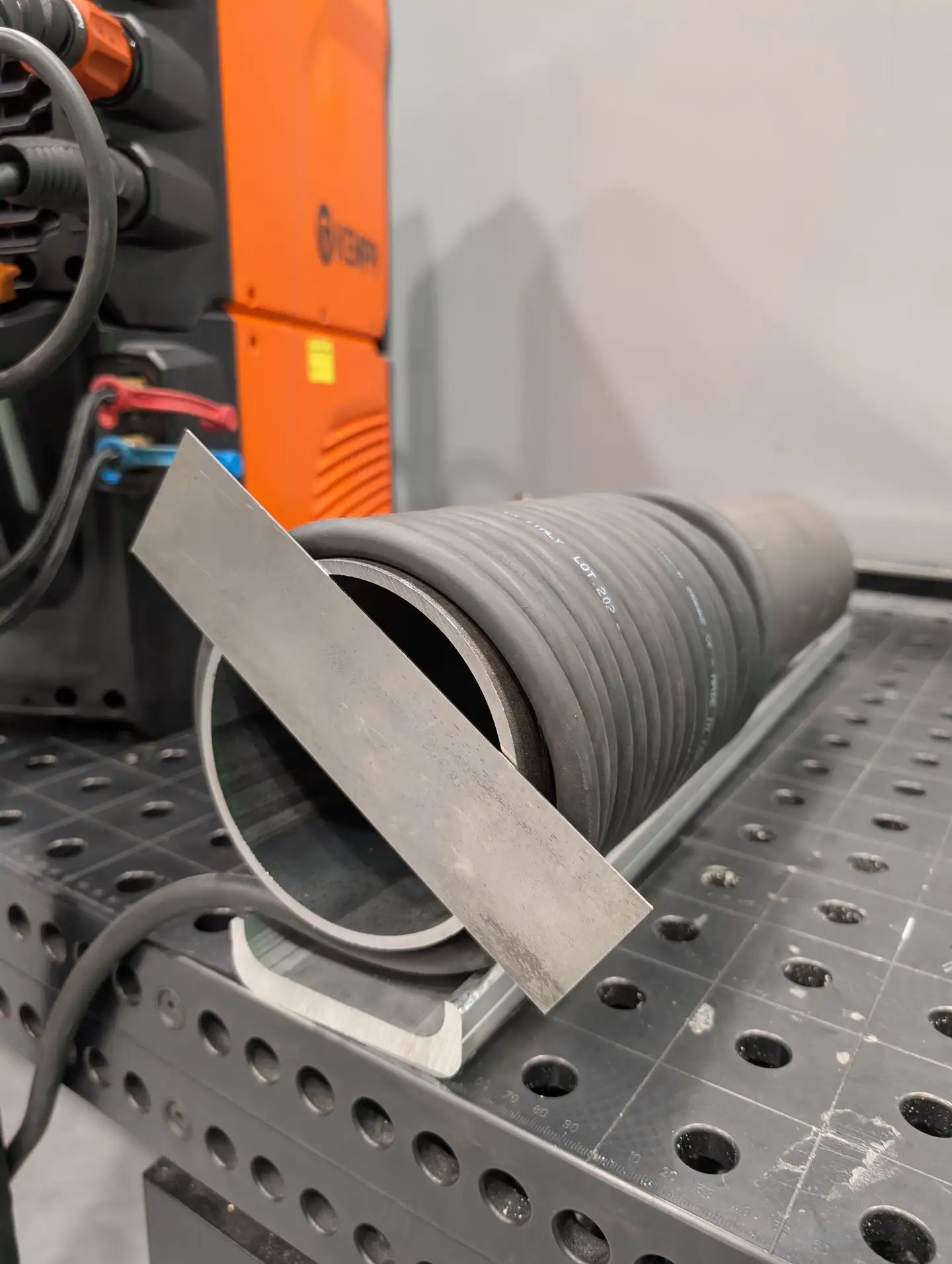
Around 5 to 20 mT can start to affect arc stability while readings over 20 mT often causes major welding issues. If a measuring device isn’t available, a quick practical test can help. A thin steel sheet can reveal magnetism if it sticks to the end of a pipe.
Removing the problem
Magnetism can be removed from steel parts using AC current. Traditionally, this requires wrapping a cable around the workpiece and carefully reducing the alternating current to zero—a method that can be quite tricky without specialised equipment.
Now, there’s an easier way.
Kemppi’s new Master T TIG machine family includes an automatic demagnetization function in all AC/DC models. The process is simple: Just follow the on-screen instructions, press the ‘Start’ button, and in about 30 seconds, the magnetism is gone. No extra tools needed.
www.kemppi.com