Initially providing a ‘Total Laser Maintenance’ service, TLM Laser now offers a complete range of laser products from some of the leading globally renowned names in laser technology. The company prides itself on being a ‘solutions’ provider with long term experience and cutting edge expertise. Here, the company’s experts focus on laser hardening.
In laser heat treating, energy is transmitted to the materials’ surface in order to heat it in a closely controlled way to between 900°C and 1,300 °C to create a hardened layer by metallurgical transformation. The laser is used as a heat source, and rapidly raises the surface temperature of a small part of the material. Heat sinking of the surrounding volumetric mass provides rapid self-quenching, thus producing a hardened transformation layer. Therefore, no oil or water is required for quenching.
This makes laser hardening cleaner and more readily mobilised than traditional heat treatments. Any ferrous metal (steel or cast iron) that would normally be hardened by more traditional methods like flame or induction hardening, can be hardened with a laser. The process of laser hardening is more versatile than flame hardening or induction hardening.
It provides reliable, repeatable, non-contact and energy-efficient heat in a minimal amount of time. For hardening, the laser beam provides the necessary control and accuracy to focus the heat to a specific area of the part. The laser is suitable for integration within already existing manufacturing equipment and production lines.
Apart from the traditional hardening process, laser hardening offers a range of applications for tasks that could not be solved hitherto, such as components with special forms and special functional surfaces. This includes selective hardening of single workpiece surfaces. Here a selective hard surface arises with a tough centre and uninfluenced areas in the surrounding material: Hardening tracks at cutting edges, guide tracks, grooves and free mould surfaces with continuous crossing geometry: Good hardenability of surfaces which are difficult to reach such as craned grooves, flutes and interior surfaces.
Dot hardening at naps and in blind holes, as well as hardenability of thin, warp-prone parts by a selective, quick heat input at an extremely short and well-timed intervals can also be achieved.
Going mobile
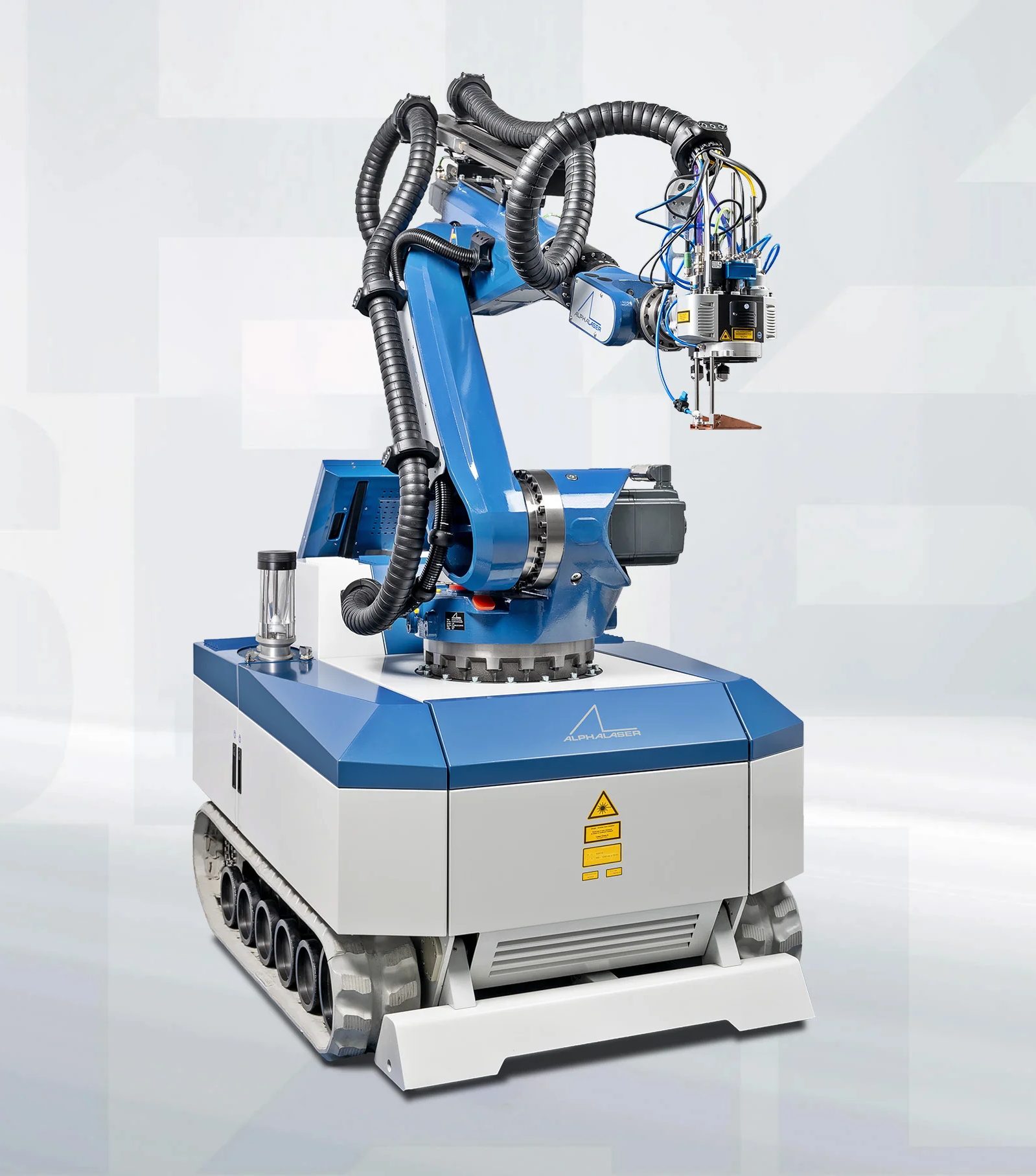
The AL- Rock is said to be the world’s first mobile robot for targeted laser hardening of metal surfaces. Equipped with a 4 kW laser it is the ultimate mobile robot for surface metal hardening or for welding with wire or powder. The system is truly mobile because all components such as the laser, cooler and robot controller are integrated in the robot chassis. This eliminates the need to transport the control cabinet and other large accessories. The energy chain is located on the robot. The HMI with AL-APP is also integrated but can be removed and placed elsewhere.
Whether on site at the customer‘s facility or at any changing locations, with the self-propelled caterpillar track, you drive the laser directly to the workpiece. The time-consuming removal of components to be processed can be omitted and the amount of reworking required is significantly reduced. All that is required is free access of the laser beam to the processing area. And above all, the system is ready for use within 5 minutes. The laser beam precisely follows the workpiece contour in free 3D movements. This makes it easy to harden closing edges, grain structures, dimples or individual points.
The temperature-dependent control of the laser power applies the heat precisely to the desired spot to achieve maximum hardness there. The surrounding areas of the component experience little to no thermal stress. For quality control, the process is documented during the hardening process, so that process reliability and reproducibility are guaranteed.
All common metals can be hardened with the Al Rock including: tempered steel, structural steel, cold work steel, cast steel and grey cast iron.
Automated powder deposition welding
With the AL-Rock mobile, however, you can also carry out powder and wire deposition welding. The powder conveyor or the automatic wire feed is then also already integrated.
Depending on the application, different laser processing optics are optionally available, with which seven different processes can be carried out: Deep penetration welding, wire deposition welding, sweep welding, hardening with scanner optics, 3D printing, powder deposition welding and pulse welding. Exchanging the optics is accomplished in a matter of minutes.
As a scanning process head, the LASERHEAD-S is used for surface processing tasks. Complex laser hardening applications, but also laser welding and laser soldering tasks, such as gap bridging, can be carried out on a scan field of up to 250 mm edge length. For hardening, the LASERHEAD-S is additionally equipped with a thermal camera. The monitored temperature range is segmented.
Various wobble patterns are available for selection or can be edited by the user. Among other things, this can counteract the formation of cracks when processing difficult materials. Direction-independent hardening is possible with a track width of 1 to 40 mm in X and Y respectively.
The LASERHEAD-P is used for joint welding, deep and pulse welding as well as for powered deposition welding and 3D buildup. Surfaces, lines or any geometries can be applied regardless of direction. By multi-layer coating of suitable materials, almost any layer thickness can be achieved, and 3D volumes can also be generated. For this purpose, the powder welding nozzle as well as a thermal camera are additionally mounted on the LASERHEAD-P. The powder conveyor for 1.5 or 5 liters powder is integrated into the robot system.
For joint welding, the powder nozzle is dismounted and replaced by a suitable welding attachment.
www.tlm-laser.com