Welding is a demanding and responsible job. Joining metal requires not only in-depth knowledge of welding technology and metallurgy, but also a high degree of experience – especially when it comes to complex components such as the subassemblies of modern freight cars. These powerhouses made of high-strength steel must withstand tensile forces of up to 550 kN and shock loads of up to 18 g. Welding is usually carried out using the MAG process – often in difficult positions, frequently also at an angle. The torch guidance must be precise. Welding specialists themselves control how many emissions they generate in the process.
It is not only process variants and extraction technology that are important in terms of emission rates. Process parameters play a particularly important role in metal inert gas welding (MIG/MAG). Wire feed speed, arc length, and correction parameters influence the amount of pollutants. The ‘Institut für Schweißtechnik und Fügetechnik’, ISF (Institute for Welding and Joining Technology) at RWTH Aachen University and Fronius have examined various parameter settings.
Optimising the arc
Welding was carried out using the Fronius TPS 500i welding machine and Pulse Multi Control (PMC), an optimised pulse arc. Compared to the standard arc and the Low Spatter Control (LSC) arc, the pulse arc had the most advantageous material transfer and, as a result, the lowest welding fume emission rate (FER = Fume Emission Rate). The study also examined how different torch positions, wire feed speeds, wire feed speeds, and arc length corrections affect the emission rate.
Welding fumes can be significantly reduced by carefully selecting the welding process, wire feed speed, and arc length. In addition to other aspects such as material or impurities (scale), the welding fume emission rate also depends on the melting or process power, whereby the material transfer is decisive. If an arc becomes too short, this leads to higher short-circuit rates and thus to more welding fume emissions.
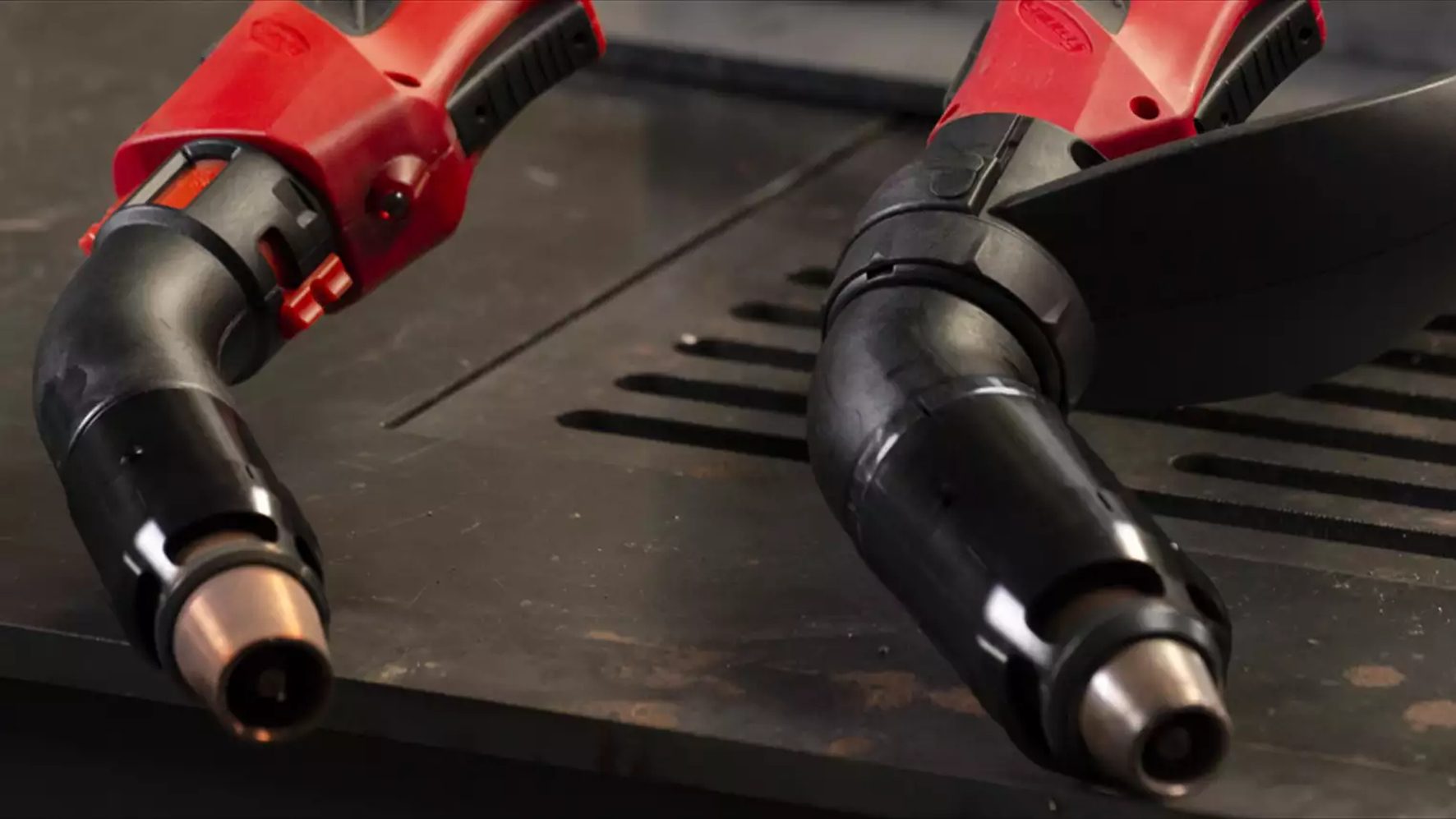
However, if the welding process is perfected with the help of arc length correction and an extraction torch such as the Fronius MTW 5001 Exento is used in combination with the Exento HighVac extraction system during joining, up to 99% of the welding fumes can be extracted.
The Exento extraction torch set provides precision extraction directly where welding fumes are produced. Fume extraction torches and extraction sets eliminate welding fumes where they are produced. Welding fumes are detected before they are able to spread, which not only protects the welder, but also everyone in the vicinity.
The Exento HighVac mobile high-vacuum extraction system ensures reliable safety during welding with an extra-large filter cartridge and semi-automated filter cleaning for a permanently high extraction capacity. The W3 certification in accordance with EN ISO21904-1 confirms the outstanding filter quality.
The power can be infinitely adjusted using the intuitive one-button operation. An integrated volumetric flow control keeps the extraction performance constant even with increasing filter saturation.
Exento HighVac can be perfectly combined with our Exento fume extraction torches for an efficient system that fulfills the requirements of EN ISO 21904-1.
During the development of fume extraction torches, particular attention should be given to the ergonomics. After all, the different size compared to conventional welding torches must not be detrimental to the health, safety, or performance of the welder.
In addition, the company’s welding helmets with blower filter units ensure optimum safety. They filter a full 99.8% of the remaining welding fume particles from the air. If welding professionals adhere to all possible protective measures, welding is not only an exciting profession, but also a fairly safe one.
www.fronius.com